Practice
Aikido for kids - how we teach it.
September 2026 · A method for young movers
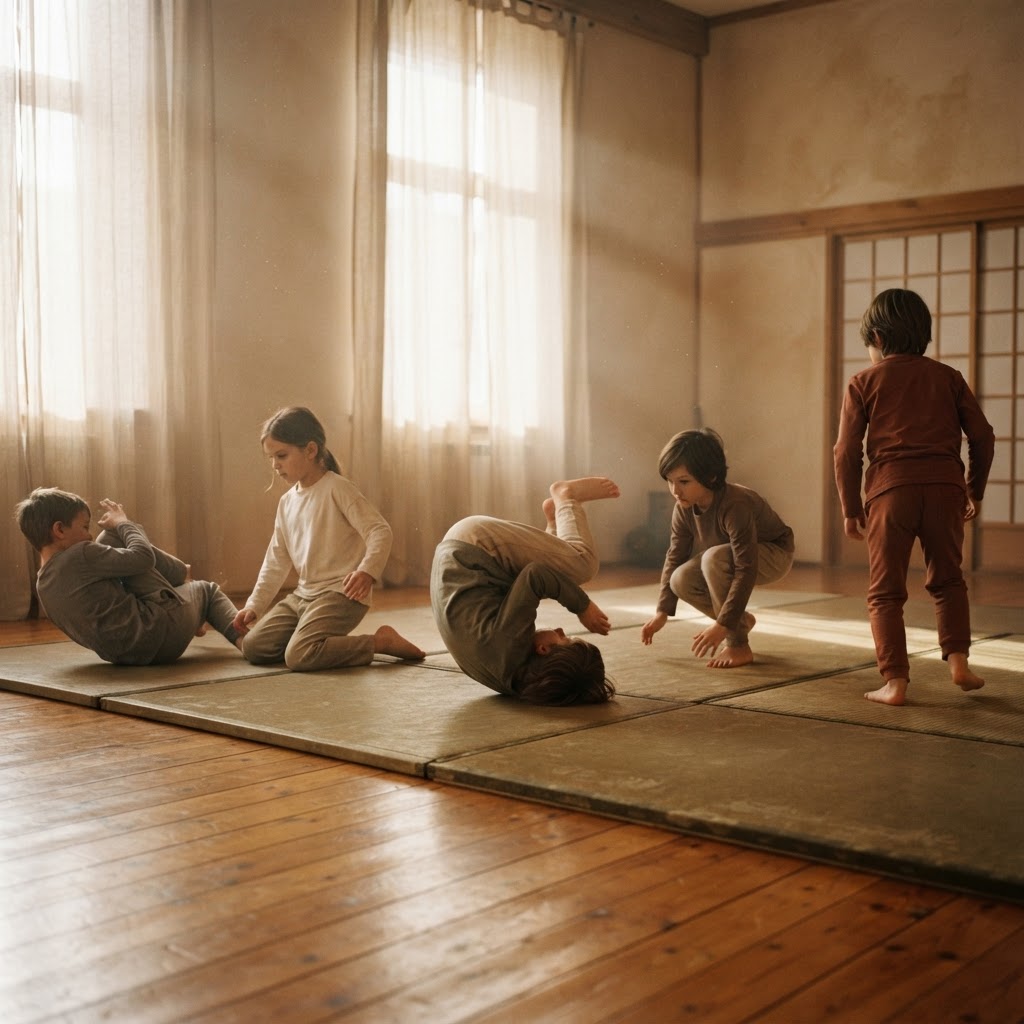
Why kids and aikido belong together -
A child's body is already a movement genius. It rolls, falls, spins and recovers a hundred times a day without ever being taught. Aikido doesn't add something foreign to that. It organises it. It takes the falling and turning children do naturally and gives it a shape, a rhythm and a partner.
Here is how we teach it - and just as importantly, what we deliberately leave out.
The first rule
Play first. Technique second.
A child who is laughing is a child who is learning. Before any technique appears on the mat, there are games: follow the leader in a low stance, rolling relays, "the ground is lava" ukemi practice. The games are not a warm-up disguised as fun - they are the lesson. Falling safely, moving low, reading a partner's energy: the games train all of it without a single correction.
Only when a movement has been lived through play do we give it a name. Then the name lands on a body that already understands it.
We never drill a child in a technique they haven't first played. A five-year-old who has rolled down a grassy hill a hundred times already knows more about ukemi than an adult who has read about it.
The core skill
Falling is the curriculum.
Ask an adult why they don't move anymore and the honest answer is often fear of falling. The most valuable thing a child can learn on the mat is that falling is not the end of the movement - it is the movement.
So ukemi comes before everything. Soft knees first. Then rolls, big and slow. Then rolls from a gentle push. We progress at the child's pace, never the plan's pace, and we stop while it is still fun.
A child who has practised falling a thousand times in a safe room carries something into every playground, every icy sidewalk, every stumble for the rest of their life.
What we leave out
No winners, no losers.
There are no tournaments in the way we teach children. Not because competition is bad, but because aikido's question is different: how do you meet force without harm? A child can practise that for ten years and never once have to defeat anyone.
The partner is not an opponent. In every exercise, both children learn - the one blending and the one giving the push. The only contest is with yesterday's own balance, yesterday's own roll.
Children who would be crushed by a competitive environment often bloom here. The mat doesn't ask them to be the best. It asks them to be present.
The invisible half
The quiet part.
Every class ends the way it begins: sitting still, breathing. Thirty seconds at the start, a minute at the end. Children arrive as hurricanes and leave as calm ones.
This is not decoration. Sitting still with a partner you just trained with teaches something no game can: how to be quiet in your own body while someone else is in the room. That is where the "kokoro" - the heart of the practice - starts.
The strongest thing a child learns here is not a throw. It is coming back to their breath after being upside down.
The whole method
Play the movement. Name it later.
Fall a thousand times safely. Meet your partner without harm. And sit quietly at the end of it all. If a child leaves the mat a little braver, a little softer and a little more at home in their body, the method worked.
The rest - the techniques with Japanese names - is just what falls out of that along the way.
Let them move.
Children don't need to be taught how to move. They need a place where moving well is the game. That is the whole idea.
- Saale